
Articles in Featuring Felines are written by
Patrick Roberts
Copyright © 2003-18 Purr 'n' Fur UK
Certain features on these pages use JavaScript
|
|
Articles in Featuring Felines are written by Certain features on these pages use JavaScript |
[ Home | Famous | Featuring | Fans | Fabled | Folios | Fun | Philately | Fragments | Flotsam ]

Le cimetière des chiens(The Cemetery of the Dogs) Asnières-sur-Seine, Paris
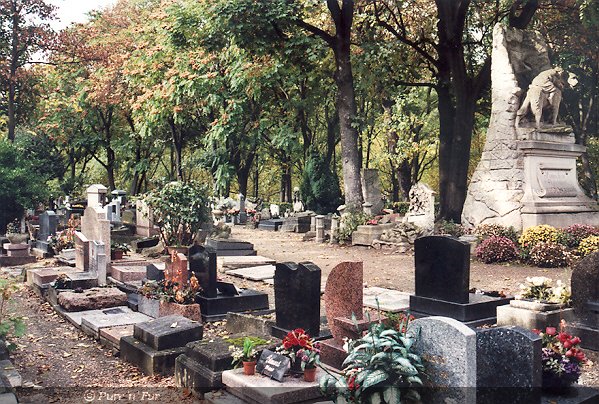
Left-click thumbnails for enlargements (JavaScript should be enabled) Why feature a dogs' cemetery?No, we haven't put this on the wrong website! Asnières-sur-Seine is a suburb of Paris, France, to the north-west of the city, just west of the river (on 'la rive gauche') and not too far from Charles de Gaulle international airport. It is also home to what is thought to be the oldest public pet cemetery in the world, 'Le cimetière des chiens', or 'Dogs' Cemetery'. Founded in 1899, it opened towards the end of summer that year, since when many thousands of animals have been buried there. It contains not only dogs, but a fair number of cats and a variety of other species, including a lion, a monkey, a racehorse, mice, birds, rabbits and more — even fish. Although not strictly a museum in the conventional sense, the cemetery is of historical interest and does contain memorials dating back well over 100 years, so we felt this was the best place to feature it on our site. The history
Financial problemsAlthough very successful initially, the enterprise has suffered chronic difficulties over the years, and by 1986 severe financial problems caused the administrative council to decide to stop any further activity and to close it for good from September 1987. However, supporters and lovers of the old cemetery, dismayed by the decision, had other ideas and started to mobilise. As a result the mayor's department of the town prepared a plan to save it and requested the state authorities to list the site as one of historical interest. Eventually this was agreed and it was recognised as being of 'picturesque, artistic, historical and legendary interest' and its immediate future was secured. Work was done to consolidate the river bank at the site, and from 1 February 1997 the community of Asnières took over responsibility for the cemetery. Views of the cemetery
Famous dogs
Resident catsThe Asnières pet cemetery provides sanctuary for a number of living domestic cats who have the run of the place. They are not feral and although some are wary, others are quite willing to greet and pass the time of day with a stranger — especially if that person carries a few cat biscuits! These cats are fed regularly and are supported by an organisation that looks after their welfare. They have a small shelter with a cat flap at the back of the cemetery, where they can take refuge if they wish.
Cat memorials
I recommend a visit here to any animal lovers with a bit of time to spare when visiting Paris. It's not hard to reach and is a tranquil, attractive and interesting place.
Statues and a few older memorials at the cemetery
Finally, a selection of old postcards,
Links
See also our page on the PDSA Animal Cemetery at Ilford in Essex, part of our Cats in Wartime series. Although the emphasis of the article is on Dickin Medal recipients buried there (in particular, Simon of the Amethyst), the information and images may be of interest. |
If you'd like to comment please contact me,
Drop in at our Facebook page

Return to:
Featuring Felines index
for more real-life stories and adventures of cats
Other sections:
Famous Felines
Fabled Felines
Feline Folios
Feline Fun
Fans of Felines
Feline Philately
Feline Fragments
Feline Flotsam
or visit the Purr 'n' Fur home page

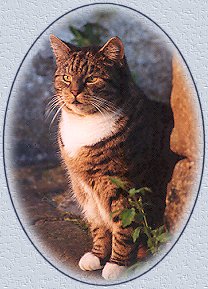
Our featured feline at the head of the page is Socks, pictured in 2003 surveying his 'estate' in the early morning sunshine. Affectionately known as Soxy, he blossomed from a thin and hungry stray into a substantial and handsome cat who loved life and company, and his gentle ways endeared him to many friends. He is now no longer with us, but you can read more from his human companion here.
Copyright © Patrick Roberts & Purr 'n' Fur UK 2003-18
All rights reserved
Images and content (whether original or used at Purr 'n' Fur with permission) may NOT be reproduced
at another website or otherwise copied or used without prior permission.
Direct linking (hotlinking) to ANY images on this site is strictly forbidden.
If you want something,
!
Page created December 2009, with later revisions
 "Durand Street plaque - click to enlarge")
 "Entrance to the cemetery - click to enlarge")
 "Entrance gates - click to enlarge")
 "View of the cemetery - click to enlarge")
 "View of the cemetery - click to enlarge")
 "View of the cemetery - click to enlarge")
 "View of the cemetery - click to enlarge")
 "View of the cemetery - click to enlarge")
 "View of the cemetery - click to enlarge")
 "View of the cemetery - click to enlarge")
 "View of the cemetery - click to enlarge")
 "View of the cemetery - click to enlarge")
 "View of the cemetery - click to enlarge")
 "View of the cemetery - click to enlarge")
 "Memorial to St Bernard rescue dog Barry - click to enlarge")
 "Canine film star Rin Tin Tin - click to enlarge")
 "Rin Tin Tin's grave and memorial - click to enlarge")
 "Resident cat - click to enlarge")
 "Resident cat - click to enlarge")
 "Resident cats - click to enlarge")
 "Resident cat - click to enlarge")
 "Resident cats - click to enlarge")
 "Resident cat - click to enlarge")
 "Resident cat - click to enlarge")
 "Resident cat - click to enlarge")
 "A simple modern memorial to Zita, 1989-2008 - click to enlarge")
 "A more elaborate memorial to Katia, Moune and Bambi - click to enlarge")
 "Brunette, 1967-1983 - click to enlarge")
 "Bullett, 1986-2003 - click to enlarge")
 "Cachou and Smoky - click to enlarge")
 "Carina, Moumoune, Bobby - click to enlarge")
 "Memorial, no inscription - click to enlarge")
 "Caty, 1948-57 - click to enlarge")
 "Cesare and Ramses - click to enlarge")
 "Chatchat, 1963-80 - click to enlarge")
 "Chipie and Jaguar - click to enlarge")
 "To my loved ones - click to enlarge")
 "Elaborate memorial, no inscription - click to enlarge")
 "Gipsy and Wisky - click to enlarge")
 "Joujou and Kiki - click to enlarge")
 "Lara and Poussy - click to enlarge")
 "Manouchka, 2001-09 - click to enlarge")
 "Mimi - click to enlarge")
 "Minette Nouche - click to enlarge")
 "Minouchette - click to enlarge")
 "Pacha and Darius - click to enlarge")
 "Pepsi, 1999-2008 - click to enlarge")
 "Plume, 1980-1998 - click to enlarge")
 "Poupounet - click to enlarge")
 "Prisly, 1984-2001 - click to enlarge")
 "Ramses, 1982-92 - click to enlarge")
 "Utrillo, 1983-2000 - click to enlarge")
 "Guigui, 1989-98 - click to enlarge")
 "Iris - click to enlarge")
 "Daisy - click to enlarge")
 "Zebulon, 1965-82 - click to enlarge")
 "Zizou and Lady - click to enlarge")
 "Sniff and Purdey - click to enlarge")
 "Memorial to several cats - click to enlarge")
 "Cat statue at the cemetery - click to enlarge")
 "Older memorial - click to enlarge")
 "Older graves - click to enlarge")
 "Older memorial, 1894-1909 - click to enlarge")
 "Older memorial - click to enlarge")
 "Dog memorial - click to enlarge")
 "Old postcard views - click to enlarge")
 "Old postcard views - click to enlarge")
 "Old postcard views - click to enlarge")
 "Old postcard views - click to enlarge")
 "Old postcard views - click to enlarge")
 "Old postcard views - click to enlarge")