Post-war
Antarctic Cats
Left-click thumbnails for enlargements (JavaScript should be enabled)
The Wyatt Earp
This was a small former fishing trawler that had been bought in 1929 by American explorer Lincoln Ellsworth for use as a support ship in his attempt to fly across Antarctica, and named after his childhood hero. Acquired by the Australian navy in 1939, after the war the Australian government (influenced by Douglas Mawson) requested that she be refitted for Antarctic exploration. In 1947 a voyage southwards was made out of Melbourne, but the ship proved inadequate for coping with pack ice and was judged to be too old, slow and small for what was needed. It did, however, reach Antarctic waters and visited Macquarie Island.
As mentioned on our 'Antarctic Cats' page, the ship's cat was thought to be one of the granddaughters of the original 'Nigger', of RRS Discovery, and while the vessel was at Macquarie in 1948 two piebald kittens were born. They too were piebald, and were named Ninnis and Mertz, after two AAE expeditioners who had lost their lives on a sledging journey with Mawson.
British Antarctic bases
The information for the first part of our account of the post-war cats was kindly sent by Alan Carroll.
Towards the end of WW2 Britain decided to set up two bases in the Antarctic to lay claim to some of the territory and to prevent its use by enemy vessels, and also to establish places where scientific research could be carried out after the war. In February 1944 a 'most secret' Royal Naval operation codenamed 'Tabarin' set up Base A at Port Lockroy on Goudier Island, a tiny scrap of land just off Wiencke Island in the Palmer archipelago, to the north-west of the Antarctic Peninsula. One of the ships involved was HMS William Scoresby.
The following year, in March 1945 on another visit, this ship left at the base a young, male kitten known as Tubby. He was neutered shortly after arrival. The only other information available about him is that he caused an inter-base radio chess competition to be abandoned when he knocked over Port Lockroy's chess-board! It is not known what became of Tubby.

A few years later, on 3 April 1952, eight-week-old Tiddles arrived from the Falkland Islands, having been brought by researcher Ralph Lenton on the John Biscoe. He quickly settled in and didn't seem to mind the personnel changes that took place each summer; however, he disliked all the fuss and disturbance when mail ships arrived and there was an influx of people. His favourite pursuit was bird-watching, which he would do for hours on end either from beneath the hut or from the vantage point of a shelf situated under the living-room window. In good weather he would go outside and attempt to stalk the birds.
At night, or in bad weather and during the long winters, Tiddles' favourite spot was on top of the most powerful transmitter in the radio room; it was kept on standby and so was always warm. Sad to say it was also his undoing. On 2 March 1955, when jumping down from his perch, he dislodged a heavy piece of equipment that fell on him and he had to be put down. Tiddles was buried under a cairn at the north of the island.
 In January 1958 a third kitten, this time a female, was brought ashore by Alan Cameron from one of the ships unloading stores. She had been donated by the wife of the Falkland Islands Colonial Secretary and was named Bridget. For some reason her name was later changed to Dizzy for a year or so, before reverting to Bridget. She shared quarters with a mongrel dog called 'Peso', who had been a ship's mascot. Bridget seems to have been quite a character and she made a strong impression on base personnel from the day of her arrival until she was returned to the Falkland Islands in January 1962, when Port Lockroy base was closed down. The photo of Bridget shows her climbing the nearest thing to a tree within 949 miles!
Note: Following a survey in 1994 by the UK Antarctic Heritage Trust, the Port Lockroy station was refurbished and reopened in 1996 for the benefit of the growing number of Antarctic tourists.
* * * * * * * * * *
Robert Burton continues our account with his memories of Ginge, the resident cat at the British Antarctic Survey (BAS) base on Signy Island, a small island of the South Orkneys group, when Robert arrived there in November 1963.
'The cat was trying to look inconspicuous in the snow and failing miserably,' says Robert. It was unusually sunny, and Ginge was trying to stalk sheathbills but without much success: in fact some of them circled round behind him as he stalked, and pecked at his tail as it twitched in frustration!
 No one seemed to know how long Ginge had been there at the base; he was just 'part of the furniture', providing one of the few sources of entertainment and amusement. Robert especially remembers the cat's welcome company when alone on night-time meteorological duty, when everyone else was in bed. Ginge, too, liked company; sometimes he would wander into the kitchen and mew repeatedly, but not always because he wanted food or drink — he just wanted to be spoken to and have a little affection. He was quite a talkative animal, possibly with a little Oriental blood somewhere in his ancestry.
 Unfortunately, although Ginge had no luck with the sheathbills, it was a different story with the petrels, which he hunted mercilessly as they scuttled to their burrows at night. Eventually the Senior Biologist decided that it made no sense to keep a cat that killed the wildlife the survey was supposed to be studying, and 'something had to be done'. For a time it looked as though Ginge might be headed for the same fate as Mrs Chippy — but then fate decreed otherwise.
Robert developed a very severe toothache, and with no effective treatment available at the base he had to be sent to a dentist in the Falkland Islands. Ginge was allowed to accompany him — but might have wished he hadn't when their ship, the MV Kista Dan, hit a bad storm on the first day that lasted well into the night. Robert was seasick, and Ginge's box was sliding around all over the place with him inside, wailing. By morning things had calmed down sufficiently for the cat-friendly ship's cook to be located, and he looked after the feline traveller.
After another four days they arrived, and Ginge joined his new family. Later he was reported to have moved to the UK, where he had a well-earned and happy retirement. Following his dental treatment Robert Burton returned to Signy - but Ginge was no longer a part of life there and there was little alternative to playing endless games of patience during the long nights alone.
Read Robert's full and entertaining account of Ginge in his own words.
* * * * * * * * * *
Judith was a tabby female named after the 'base sweetheart' — Judith Durham, of the then very popular singing group The Seekers. Judith the cat's story is told by Steve Chellingsworth:
'The sealers had deliberately introduced cats to South Georgia in the late nineteenth century in order to control the rats (which they had accidentally introduced earlier). Somehow, both rats and cats managed to co-exist, and when the whalers finally left in 1964, both rats and cats continued to survive.
'In the Antarctic summer of 1914, Shackleton's Endurance lay at Grytviken for a month. The ship's complement included the carpenter's cat, Mrs Chippy (who was actually a Mr), a tiger-striped tabby "with dramatic markings". It is difficult to believe that, in the course of that month, he did not take the opportunity of some shore leave, and even more difficult to believe that once ashore, "Mrs" Chippy did not indulge in a little mating with some of the local resident cats. It is a fair bet that somewhere around King Edward Cove there were at least a few cats marked with the late Mrs Chippy's genes. Among cat markings the tabby gene is dominant.
'In 1970, while working at the BAS station on King Edward Point, I was "adopted" by a tabby cat who used to visit me regularly through the east door of Shackleton House. Like all the South Georgia cats she was small and emaciated, and grateful for any supplement to her bare subsistence diet. She would quite happily eat almost anything — even corned-beef sandwiches — but her particular favourite was tinned pilchards (in tomato sauce), which were unpopular among the human inhabitants and were always left over in the end-of-month food store.
 'With alarming regularity, "my" tabby Judith would suddenly start to put on weight and withdraw from circulation for a couple of weeks. She would then reappear, thin, hungry and very, very thirsty. It did not take long to work out why, and such was her confidence that if I produced, but did not serve, an opened tin of pilchards she would lead me to the secret hiding place of her litter. On the last occasion, this was in the darkest recesses under the stairs of the luxurious but safely abandoned Magistrate's Residence, halfway down the track between Shackleton House and the jetty.
'Then one day, Judith and her litter mysteriously disappeared. Rumour had it (and it's surprising how fast rumour can spread in a 10-man community) that the kittens had been drowned in the Cove by an unsympathetic base member who felt that the Magistrate's House had somehow been demeaned by their presence. On Judith's fate, rumour was silent and, despite many doorstep inducements, the east entrance of Shackleton House remained unvisited. Weeks went by, then months.
'But, just as the RRS Bransfield arrived on her maiden voyage to relieve the base and return me to "civilisation", Judith suddenly reappeared. She was small and emaciated, as before, but now untrusting. She would neither enter Shackleton House, nor accept any food — not even pilchards; but she did reappear at the east door. It was almost as if, against her better judgement, she had come to say "Goodbye".
'Was Judith really Mrs Chippy's great-great-granddaughter? We will never know. But I am inclined to believe the photographs . . .'
Some final comments from Alan Carroll:
'Many Base members enjoyed the company of these cats, but inevitably there was some dissension. The 21 October 1945 issue of the monthly newssheet the Hope Bay Howler contained a contribution "from our Southern Correspondent at Port Lockroy": This reads:
"In the unlikely event of our advice being sought by those proposing to settle in the Antarctic, we can only say, 'Do not keep a cat.' Not only does this totally useless animal fall under suspicion of fouling our drinking water, playing havoc with stores, specimens and anything else handy, but it will also divide your household into pro- and anti-cat factions. If you consider life incomplete without this animal, do not in any case import one of the Falkland Islands breed, in which biologists have detected strong strains both of the monkey and of the rat."
'Despite occasional lyrical tales about such "pets", it is unfortunately true that most arrived down south as the result of being unwanted elsewhere.'
Very warm thanks go to Alan Carroll, Robert Burton and Steve Chellingsworth for taking the trouble to dig out their archives and share with us their recollections of Antarctic Base cats.
Halley Bay cats
Thanks go to Jean Sinclair, who directed us to information concerning the cats at another Antarctic station, Halley Bay. A base was set up there in 1956 by the Royal Society, preparatory to the International Geophysical Year in 1957-58. It was in Coats Land, on the Weddell Sea, and still operates as Halley Research Station, now run by the British Antarctic Survey (BAS). The 'Bay' was removed from the name after Halley Bay itself disappeared during changes in the ice topography.
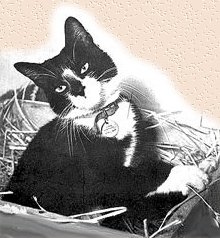
Strom and Ness were smuggled out to the base in 1960 from the Stromness whaling station, then in South Georgia. By early 1962 Ness had disappeared; it wasn't clear what happened to her, but she could have become a victim of dogs. A further female cat was therefore brought from Stromness on board the vessel Kista Dan, to provide a new companion for Strom; she was named Kista. Her favourite sleeping position was on a shelf above a desk next to the geophysics office heater, which remained on 24 hours a day (trust a cat to find the best spot!).
Strom died rather mysteriously in 1963, but an autopsy showed that he had eaten a quantity of indigestible wood shavings, which almost certainly caused his demise. At some point there was said to be a cat called Dan (also named from Kista Dan), but we have no further information about him/her. There was also a male called Kosmo, who came from Stanley in the Falkland Islands; he and Kista were put down in January 1969 (for reasons unknown to us), but not before they had kittens, which were named Dougal and Zebedee after characters in the very popular children's TV show of the time, The Magic Roundabout. These youngsters, too, were short-lived and died early in 1970, but again not before the female, Zebedee, had a kitten. He was called Dylan (below right), after the rabbit in the same TV programme.
 The cats at the base were fed mainly on tinned salmon, but after one of them became quite ill the doctor suggested this was an unbalanced diet and so it was changed, solving the problem. Dylan still became expert at hearing the sound of a tin of salmon being opened; he would come hurtling along the corridor and flying through the cat-flap in the door of the meteorological office, skidding to a halt by his food bowl. Dylan's sleeping place was in a cardboard beer carton under a lamp. He was an accomplished climber, even of ladders. He once managed to climb 30 feet (nearly 10 metres) of icy rungs to reach the continental surface, where he suffered frost nip to his ears and was also tossed some distance in the air by a husky dog he encountered. Luckily a passing scientist came to his rescue and returned him to his refuge, where he lived until July 1973.
Lastly there was a cat called Puff (after the magic dragon?), who arrived at the base in February 1971, but died late in August of the same year.
Scott Base
This base, named after Robert Falcon Scott and originally established in support of the Commonwealth Trans-Antarctic Expedition and the International Geophysical Year of 1957, was handed over to be run by New Zealand in 1958. That same year it's reported that a tabby kitten, which had been taken to McMurdo Station by a US Navy man, was rescued from McMurdo and spent the winter at Scott Base. The following summer it was returned to New Zealand — and on seeing grass and trees 'took off' and was never seen again!
(Thanks to Anthony Powell for sending this information.)
Notes
Animals played an important role in the life and morale of research bases, especially during the isolated winter months; but under the terms of the international Antarctic Treaty system, and to protect the fragile environment, ecology and indigenous wildlife, non-native species are no longer permitted. This includes pets such as cats and dogs, as well as live poultry and plantlife, including houseplants. For this reason huskies, introduced from Labrador in 1945 by the Falkland Islands Dependencies Survey (FIDS, the predecessor of the British Antarctic Survey), and essential for inland travel, exploration and mapping at that time, have also disappeared from Antarctica. In practice the necessity for their use as sled-dogs had largely ended in the mid-1970s on being replaced by planes, snowmobiles etc; but some remained and were still used — latterly recreationally and for companionship — the last being based at Rothera station.
However, after one last sledge journey to say 'a final farewell to these dogs and a 'thank you' to generations of loyal, friendly animals', the last two teams — the Admirals and the Huns — left the continent on 22 February 1994, banished by the international community as a non-indigenous species, to the lasting regret of FIDS/BAS staff who had known, cared for, handled and been involved with generations of these hardy animals over the previous 50 years. As descendants of Inuit Sled Dogs they represented an important genetic stock, and it had been decided to return them to their ancestral homeland. Thus they journeyed via the Falklands, Britain and America to the north of the Canadian province of Quebec, and were presented to the Inuit community at Inukjuak on the Hudson Bay coast. Sadly, despite having been inoculated, almost half their number succumbed to a canine virus in less than a year. Breeding from the remaining animals was unsuccessful, and it's understood the last two British Antarctic huskies died in 2001.
In 2006 the British Antarctic Survey Sledge Dog Memorial Fund was set up by FIDS/BAS personnel to mark the contribution of polar dogs to exploration, and in mid-2009 a full-size bronze statue of a 'British Husky' was unveiled outside the entrance of the BAS headquarters in Cambridge, UK, together with a commemorative plaque listing all the dog teams that had worked and travelled in the British Antarctic Territory. A fitting tribute, it notes that '1,204 dogs worked in these teams from 1945 to 1993' and that the monument was 'Erected by their companions and friends 2009'. We believe there was discussion about placing similar plaques at BAS locations in the Antarctic, but are not sure if these plans were fully realised — we think that one plaque is now sited at the Rothera base.
Antarctic cats, however, did not fulfill the same kind of role, and are unlikely to be remembered except by those to whom they provided valued companionship.
Sources & further links
Further feline memories and photos are invited from any BAS personnel who may read these accounts,
or indeed from any nation working in the Antarctic who may have had base cats.
This is the second of two articles: the first, Antarctic Cats, is an account of several felines involved with polar exploration in the late 19th and early 20th century. A separate page recounts the story of Mrs Chippy of Shackleton's Endurance.
There is also the story of ship's cat Halifax who over-wintered in the ice of the high Arctic 1994–95.
You may be interested to read about other, non-feline Antarctic pets at the Antarctic Circle site,
or about other aspects of the Antarctic

 An interesting supplement to the tales of Antarctic cats is the following. Late in 2006 a large Irish expedition named 'Beyond Endurance', with some 80 members, set sail in the ship Ushuaia for South Georgia to follow in the footsteps of their countrymen Shackleton, Crean, Forde, Keohane and the McCarthy brothers. They visited the sites in South Georgia of the Endurance expedition of 1914-17, and 32 members of the group traversed the island following the route of Shackleton, Crean and Worsley when they went to the rescue of the men stranded on Elephant Island. The group were also able to visit South Orkney.

 Expedition member Margaret Johnstone — a Scot — contacted us to let us know of the project after reading our account of Mrs Chippy. She says there were at least four Scots (apart from the cat!) in Shackleton�s Endurance — and because she was sure few of the 'Beyond Endurance' members knew of Mrs Chippy, she took along a replica (left and right) to tell his part in the story. Margaret said it was 'the journey of a lifetime', and kindly sent us these photos. 'Mrs Chippy' spent most of the voyage resting on top of the water cooler in Ushuaia's lounge — but he also spent a night camping out near Port Lockroy (above left) on the Antarctic Peninsula (see the front of the tent, above right).
We were delighted to hear of this sequel to the Mrs Chippy story, and warmly thank Margaret for sharing it and her photos with us.


 "Strom, of Halley Bay - click to enlarge")
 "Strom relaxing - click to enlarge")
 "Strom and Ness at the front door, Halley Bay - click to enlarge")
 "Ness being adventurous - click to enlarge")
 "Kista, Halley Bay - click to enlarge")
 "Kista asleep - click to enlarge")
 "Kista - click to enlarge")
 "Dylan, Halley Bay - click to enlarge") The cats at the base were fed mainly on tinned salmon, but after one of them became quite ill the doctor suggested this was an unbalanced diet and so it was changed, solving the problem. Dylan still became expert at hearing the sound of a tin of salmon being opened; he would come hurtling along the corridor and flying through the cat-flap in the door of the meteorological office, skidding to a halt by his food bowl. Dylan's sleeping place was in a cardboard beer carton under a lamp. He was an accomplished climber, even of ladders. He once managed to climb 30 feet (nearly 10 metres) of icy rungs to reach the continental surface, where he suffered frost nip to his ears and was also tossed some distance in the air by a husky dog he encountered. Luckily a passing scientist came to his rescue and returned him to his refuge, where he lived until July 1973.
The cats at the base were fed mainly on tinned salmon, but after one of them became quite ill the doctor suggested this was an unbalanced diet and so it was changed, solving the problem. Dylan still became expert at hearing the sound of a tin of salmon being opened; he would come hurtling along the corridor and flying through the cat-flap in the door of the meteorological office, skidding to a halt by his food bowl. Dylan's sleeping place was in a cardboard beer carton under a lamp. He was an accomplished climber, even of ladders. He once managed to climb 30 feet (nearly 10 metres) of icy rungs to reach the continental surface, where he suffered frost nip to his ears and was also tossed some distance in the air by a husky dog he encountered. Luckily a passing scientist came to his rescue and returned him to his refuge, where he lived until July 1973.  "The overnight campsite near Port Lockroy - click to enlarge")
 "'Mrs Chippy' outside the tent - click to enlarge") An interesting supplement to the tales of Antarctic cats is the following. Late in 2006 a large Irish expedition named 'Beyond Endurance', with some 80 members, set sail in the ship Ushuaia for South Georgia to follow in the footsteps of their countrymen Shackleton, Crean, Forde, Keohane and the McCarthy brothers. They visited the sites in South Georgia of the Endurance expedition of 1914-17, and 32 members of the group traversed the island following the route of Shackleton, Crean and Worsley when they went to the rescue of the men stranded on Elephant Island. The group were also able to visit South Orkney.
An interesting supplement to the tales of Antarctic cats is the following. Late in 2006 a large Irish expedition named 'Beyond Endurance', with some 80 members, set sail in the ship Ushuaia for South Georgia to follow in the footsteps of their countrymen Shackleton, Crean, Forde, Keohane and the McCarthy brothers. They visited the sites in South Georgia of the Endurance expedition of 1914-17, and 32 members of the group traversed the island following the route of Shackleton, Crean and Worsley when they went to the rescue of the men stranded on Elephant Island. The group were also able to visit South Orkney. "'Mrs Chippy' asleep on the bow of Ushuaia - click to enlarge")
 "'Mrs Chippy' and the Beyond Endurance expedition logo - click to enlarge") Expedition member Margaret Johnstone — a Scot — contacted us to let us know of the project after reading our account of Mrs Chippy. She says there were at least four Scots (apart from the cat!) in Shackleton�s Endurance — and because she was sure few of the 'Beyond Endurance' members knew of Mrs Chippy, she took along a replica (left and right) to tell his part in the story. Margaret said it was 'the journey of a lifetime', and kindly sent us these photos. 'Mrs Chippy' spent most of the voyage resting on top of the water cooler in Ushuaia's lounge — but he also spent a night camping out near Port Lockroy (above left) on the Antarctic Peninsula (see the front of the tent, above right).
Expedition member Margaret Johnstone — a Scot — contacted us to let us know of the project after reading our account of Mrs Chippy. She says there were at least four Scots (apart from the cat!) in Shackleton�s Endurance — and because she was sure few of the 'Beyond Endurance' members knew of Mrs Chippy, she took along a replica (left and right) to tell his part in the story. Margaret said it was 'the journey of a lifetime', and kindly sent us these photos. 'Mrs Chippy' spent most of the voyage resting on top of the water cooler in Ushuaia's lounge — but he also spent a night camping out near Port Lockroy (above left) on the Antarctic Peninsula (see the front of the tent, above right).

 "Ginge relaxing, BAS base, Signy Island - click to enlarge")
 "Ginge trying to stalk a sheathbill, Signy Island - click to enlarge")