Antarctic Cats
19th and early 20th century expeditions
This is a companion to our account on a separate page of Mrs Chippy who accompanied
Ernest Shackleton and his crew on the Endurance on their voyage to the Antarctic in 1914.
See also Post-war Antarctic Cats at research stations
Click thumbnails for enlargements (JavaScript should be enabled)
The first cats to visit Antarctica were ships' cats on expeditions and sealing vessels in the early nineteenth century. The first cat, name unknown, to overwinter on shore belonged to the sealing vessel Cora which was wrecked on Desolation Island in the South Shetland Islands in 1820. It was rescued with the crew and eventually returned to England. Another anonymous feline achieved notoriety in 1843 when a Royal Navy expedition, commanded by James Clark Ross on HMS Terror, was exploring the coast of Antarctica. While chipping ice from the bow of the ship, a small fish of a previously unknown type was revealed. It was carefully removed and sketched but, before it could be preserved for posterity, it was eaten by the ship's cat!
In the 'heroic age' of Antarctic exploration there were numerous ships' cats. Below we recount the stories of those we have been able to track down, with the valued assistance of several people whose names are acknowledged at the foot of the page.
Belgica
 Another cat to spend a winter in Antarctica was Nansen, a black-and-white kitten that sailed on the Belgian sailing ship RV Belgica in 1897, under the command of Captain Adrien de Gerlache on the first completely scientific expedition. Nansen was brought aboard by the Norwegian cabin boy Johan Koren, and was named of course after his country's great Antarctic explorer Fridtjof Nansen. He became a great favourite of the crew; but when the ship became trapped in the ice and had to spend the entire winter there, Nansen's personality gradually changed; he became ill at ease, ate little, slept more and was angry and unfriendly if disturbed — he seemed to become almost deranged. Despite the best efforts of the crew he died on 22 June, midwinter's day, but whether it was the demoralising permanent cold and darkness that caused his death is unclear. He is featured in a book by the ship's doctor, Frederick Cook, Through the First Antarctic Night.
The Swedish ship Antarctic
Some of the most heroic cats were those on the 1901-1904 Swedish Antarctic Expedition led by Otto Nordenskjöld in the ship Antarctic, under the command of Captain C.A. Larsen. The ship was crushed by ice in the Weddell Sea and sank. The crew escaped across the ice floes to Paulet Island, taking two cats with them. It was recorded that, 'The ship's cats are carried down in a state of terror. All the disorder of the last month has disagreed sadly with the poor creatures; they are quite frightened out of their wits.'
 Little was known about these cats until they were researched by Swedish historian Magnus Forsberg. All the details are still not clear but, in October 1902, the cats had been brought aboard the Antarctic in Ushuaia at the southern tip of South America, the ship's last port of call. They were named Herr Olsson and Ushuaia. Herr Olsson was a male, while female Ushuaia gave birth to a single female kitten of unknown name. It seems that Herr Olsson died before the Antarctic sank, so it was mother and daughter who reached Paulet Island. Ushuaia also died at some point and eventually it was the young cat that survived the winter, living in a makeshift hut on a diet of penguin and fish.
Eventually, the following summer, the Argentine ship Uruguay was sighted off Paulet Island, to the great excitement of the stranded explorers. It was recorded that 'The cat, quite out of her wits, runs round and round the walls of the room.' Nordenskjöld and his men were taken to Buenos Aires, where they were treated as heroes, and Captain Larsen was awarded a medal by the Argentine Society for the Protection of Animals for rescuing the cat. The cat's eventual fate is unknown, but there is some evidence that she was taken back to Sweden.
The photo shows one of the Antarctic's cats, but it isn't known which one.
Scott and Discovery

 When Robert Falcon Scott sailed to the Antarctic in the brand-new, purpose-built Discovery in 1901 there were two cats on board accompanying the 48 men; they were Blackwall and Poplar (presumably named after those districts of London). Poplar, a tabby-and-white tomcat, soon attached himself to Scott, spending most nights on the captain's bunk along with Scamp, his black Aberdeen terrier; he was also friendly with a stoker named Page. Blackwall was a black female cat who became the pet of American stoker Arthur Quartley; the cats got on well together and would share their favourite warm spot by the stove (see galley tableau, below right).
In July 1902 both cats were reported to be 'doing well and flourishing in the climate'. In early December that year Blackwall gave birth to one very small kitten; and soon became pregnant again, with six kittens arriving in mid-February 1903. Discovery became stuck in the Antarctic ice for two whole winters in 1902 and 1903 before being released early in 1904 by rescue ships Terra Nova and Morning, using dynamite to blast away the ice.
Regrettably both cats came to a sad end. Entries from the diary of Lieutenant Charles Royds, which came to light only fairly recently, give the following information:
22 March 1903. Poplar, our tomcat, was put to death yesterday, by unanimous agreement of the lower deck, and was consequently dropped down an adjacent seal hole. He belonged to Page and although everyone liked the animal, and admired the way it had come through last winter with only the loss of an ear from frostbite, yet it has always been a dirty cat in its habits, and a perfect bugbear to me, so the men decided to do away with it, for which I am not sorry. We still have Blackwall and her three kittens, all going on well.
(Presumably the other kittens had died —Ed.)
2 February 1904. Last night Whitfield returned on board and apparently having let loose the two dogs who had not gone down to the camp, he proceeded to set them on the cat till the poor brute was killed. Poor beast, after being over 2 years down here, to die like that seems very hard. Apparently he has got some spite against Quartley, tho' he says not when in his sane moods.


Discovery is now berthed permanently at Dundee in Scotland (left), where she was built, and is open to visitors. Some areas of the ship have tableaux to give an idea of what life was like on board in the old days. One such tableau has the cook in the galley (kitchen), with a stuffed likeness of a black ship's cat on a barrel in the corner (right).
Morning (Scott's 1901-04 expedition)
 SY Morning was a relief vessel to resupply Scott's Discovery expedition, making two voyages to the Antarctic for that purpose, in 1902 and, as noted above, in company with the Terra Nova in 1903. On Morning when she left London in 1902 were a black female called Night (possibly shown in the photo, left) and her white kitten Noon, and also a grey tabby kitten called Morning. The latter was unfortunately lost overboard on the return voyage. There was also a cat called Bobs that belonged to the chief engineer; it too was lost overboard, on the voyage between Madeira and New Zealand.
 A log exists, written by one Leonard Burgess, who was an AB on board Morning; in December 1903 he wrote, 'The cat (Nig) gave birth to 5 kittens; the first kittens I believe born in the Antarctic.' (This would seem not to be the case in view of recent information about Blackwall's kittens: see Discovery above —Ed.) The log is held at the University of Canterbury Library in Christchurch, New Zealand.
The photo (right) of the crew of Morning dates from 1904, but it's not known whether the tabby kitten is one of Night's kittens, born as described above, or the grey tabby Morning, later lost overboard.
Terra Nova (Scott's 1910-13 expedition)
Not long before the Terra Nova was due to leave in 1910, a black kitten seems to have found his way on board, curled up in a warm corner and gone to sleep. When he emerged, little did he know he was on his way to the Antarctic! He turned out to be a great character; the men took him to their hearts, soon made him ship's mascot, and he became a source of great pleasure and entertainment for them. They named him Nigger.
 He began using up his nine lives by falling overboard at sea at least twice, being rescued by the ship's boat and revived with a little brandy. The crew had made him his own little hammock out of canvas, about 2 feet long and with his own small blanket and pillow. There is quite an art to getting into a hammock, but Nigger quickly mastered it and would contentedly sleep there, swinging to and fro between the bulkheads and quite oblivious to the fiercest storms and bad weather.
 He was asleep in his hammock when an important admiral toured the ship while it was docked in Melbourne before continuing south. Nigger opened his eyes, stared at the great man, gave a huge yawn, stretched out one languid paw and went back to sleep. The admiral is said to have been quite amused.
 It's reported that Nigger acquired a great taste for seal blubber — from the Weddell seals that supplied much of the men's needs — to the extent that he would make himself sick just so that he could stuff himself with more! Sadly, Nigger's luck ran out before the end of the second voyage from Lyttelton, New Zealand and back, and was presumed washed overboard. Reports of his demise appeared in a number of NZ newspapers in the early days of April 1912, with the following being fairly typical:
The loss of the ship's black cat, which answered to the descriptive sobriquet of "Nigger," was a sad blow to the ship's company. On the way down Nigger had a narrow escape from drowning. He either fell or was washed overboard, and the Terra Nova was stopped to pick him up. A boat was hastily lowered, and after swimming in intensely cold water for about six minutes, Nigger was picked up and returned to his rejoicing owners. Coming home, however, the fates were less kind. Nigger was lost overboard one night, and no trace of him was seen again. His pleased purr and his plaintive mew were for ever stilled.
Another report expanded the circumstances slightly by saying that 'He was missed after a heavy gale', and its closing comment was, 'He was beautiful and pleasant in his life, and in his death he is not forgotten.'
 Herbert Ponting was the expedition's official photographer and cinematographer. In 1924 he re-edited the footage taken into a feature-length silent film, The Great White Silence. The British Film Institute (BFI) acquired the original negatives in 1945 and has been the custodian ever since. In 1993 a lengthy and painstaking restoration commenced, with the result first seen at the London Film Festival in late 2010. One sequence, lasting just under a minute, shows one of Terra Nova's crew playing with Nigger on the ice and then getting him to jump through the hoop of his arms. A short snatch of the Nigger sequence can be seen in the BFI's trailer for the film at YouTube. The complete film can be viewed at the BFI site for a modest fee (or purchased on DVD), and there is information about Ponting, his brief, the footage and the restoration process. See the links below.
Deutschland
 In May 1911 Wilhelm Filchner set off for Antarctica from Germany in the Deutschland, with the intention of landing at the head of the Weddell Sea and exploring the continent. This proved impossible and the ship became trapped in the ice, near where Shackleton's Endurance would become beset in 1915. Unlike Endurance, however, Deutschland drifted north and was able to get free of the ice in September 1912 and sail home. Perhaps the safe return of the expedition was due to the presence of their 'Glückskatze' — lucky cat. The picture shows Dr Erich Przybyllok, the expedition astronomer and magnetologist, with the 'lucky cat'. (The Glückskatze is usually a tortoiseshell cat, which is popularly believed to protect a house from fire and other misfortunes; anyone who drowns a tortoiseshell cat suffers seven years' bad luck. The cat in the picture appears to be a tabby rather than a tortie, so perhaps the crew just thought of it as their 'lucky cat', regardless of colour.)
Shackleton and Quest
Ernest Shackleton's Antarctic voyage of 1914/15 during which his ship, the Endurance, was crushed by ice, has become well known. We have devoted a separate page to the story of Mrs Chippy, ship's cat on the expedition; but we have learned that initially there were probably two other cats on board. One seems to have 'jumped ship' before it even left England; the second also never reached the Antarctic, having either been lost overboard, or jumped ship in South America. We have no other details, but the information comes from the diary of one of the sailors.
 In 1921 Ernest Shackleton embarked on what turned out to be his final voyage, as he died during it. Leaving London in September, his ship Quest had on board an Alsatian dog called Query, and black ship's cat Questie. Neither was lucky enough to survive the voyage. The New Zealand Herald reported in November 1922 (after the ship had returned to Plymouth at the end of the expedition) that Questie had 'had a fit as the ship was making for South Georgia and fell overboard', and also that 'Five days before the Quest reached Capetown, in heavy seas, just as Query was making a dash for the bridge, he slipped on the iron sheeting, which was wet, and disappeared overboard.'

 Three photos of Questie have come to light. One shows the cat on the shoulder of Scout James Marr, a Scottish Scout who was chosen from among many applicants to be cabin boy and general factotum. This photo (above left) comes from Marr's book describing the voyage, Into the Frozen South, published by Cassell of London in 1923. The image was given a new lease of life when it appeared on a stamp from Tristan da Cunha commemorating the centenary of the Scouting movement (see our stamp review of September 2007). The second photo (inner right) shows Questie on the shoulder of Leonard Hussey, meteorologist and explorer with the expedition, who had been on the earlier Endurance voyage. The third (outer right) has the cat being held by Frank Worsley, sailing master of the Quest. It looks from these photos as though Questie was little more than a kitten at the time they were taken.
Mawson and Discovery

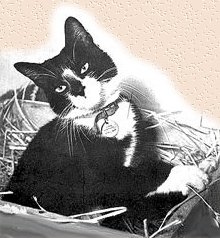
 In 1929 the Discovery sailed with Sir Douglas Mawson and the crew of the British, Australian and New Zealand Antarctic Research Expedition (BANZARE). A mascot was sought before setting sail from Cape Town — every self-respecting ship needed a mascot — and a black-and-white (piebald) female cat joined the crew shortly before departure. She was called Nigger, although answering also to 'Blackie' or 'Darkie'. While they were in the Antarctic she fell overboard one day, but Able Seaman James Hamilton Martin promptly dived into the icy water and saved her. The cat was photographed with her rescuer for the press in April 1930 (right) when the ship returned to Adelaide in Australia after her voyage. (Nigger had been born on the Antarctic research ship RRS William Scoresby, and it seems that one of her descendants continued the Antarctic connection by sailing south on the Wyatt Earp in 1947.)
 Discovery and the BANZARE crew returned for a second Antarctic voyage in 1930/31, with ship's cat Nigger again on board (left). She was thought to have gone missing on shore leave in November 1930 while the ship was in Williamstown (a suburb of Melbourne, Australia), as we have seen a copy of an advertisement offering a reward of £5 — quite a substantial sum in those days — for her safe return. However, she was later found on board, and probably had never left, as shortly after leaving Hobart in Tasmania it was reported that she had had six kittens, black and white like their mother, which she had hidden away in the depths of one of the seamen's blankets on his bunk! They were described in a press report of the time as 'six piebald piccaninnies'. Four of the kittens survived and were known as Nigger (or Nig) 1, 2, 3 and 4. Nig 1 was taken home to Adelaide by Lady Mawson, while Nigs 2, 3 and 4 were adopted by other people associated with Discovery. (One of her grandchildren, Nig 1's son, later also began a sea-going career on HMS Australia.)
Sadly Nigger disappeared, for good this time, during the return voyage from Tasmania to Melbourne at the end of the Antarctic trip, and was presumed lost overboard.
 It seems there was actually a second cat on board Discovery, at least on the first voyage, a tabby male called Tiger; he may have been the father of Nigger's kittens. A photo taken by Frank Hurley in Cape Town in October 1929 (right), shows a tabby cat being held by one of the ship�s officers in a group photo; and in the book Douglas Mawson by Lincoln Hall there's a photo of a black-and-white and a tabby cat on the shoulders of one of Discovery's sailors.
Penola

 The Penola was a small, three-masted schooner with auxiliary engines and also a De Havilland 'Fox Moth' light plane, equipped with skis and floats, which saw much use. From 1934 to 1937 it carried out the British Graham Land Expedition, a 'budget' expedition that had limited funds but in fact succeeded in achieving most of what it set out to do. The ship's cat was Peter, a tabby; but while Penola was provisioning in the Falkland Islands the dean of Stanley Cathedral presented the crew with another cat, called Lummo; he was white with patches of black.

 The two cats got on well together, but Peter's health was not robust; he disliked the severe cold and in fact died during the first winter, in 1934. Lummo, though, didn't seem to mind the cold and would even curl up in the snow sometimes. He survived the whole 3-year voyage and returned to live with a crew member's family in Woking, Surrey, where he died during WW2. Interestingly Lummo, who is also referred to as Lumus or Lummus, had a rock named after him by the expedition! Lumus Rock is situated 4 miles (7 km) WNW of Sooty Rock and marks the south-west extremity of the Wilhelm Archipelago, a series of islands off the west coast of the Antarctic Peninsula.
The Auckland Star ran this piece about Lummo in August 1937:
No member of the Grahamland Antarctic expedition, recently returned to England, has attracted more public attention than Lummo. Lummo is the expedition's cat, hailed as the only cat which has ever survived the Polar climate. At the age of three-and-a-bit, he can boast of having shared all the rigours of Antarctic exploration for more than two years.
Lummo was one of several cats which left with the expedition in 1934, but he is the only one to survive. Originally the property of the Rev. Harold E. Lumsdale, then dean of Stanley Cathedral, Falkland Islands, he started his career as an explorer at the age of six months.
So popular was Lummo with the men that by general consent he became "the First Marquess of Lumsdale" for gallant bearing in adversity. Perhaps it is not surprising that the pet should have thrived, for his diet would have filled poor home-loving cats with envy. He lived on the fat of the land, seal's liver for lunch and a breast of penguin for dinner. He never tired of this menu.
- - - o0o - - -
Our thanks
This page was first put online in 2006, with many of the original accounts summarised from Val Lewis's book, Ships Cats in War and Peace (Nauticalia, 2001). Since then it has evolved and expanded as further details have come to light. Several correspondents over the years have most kindly provided additional facts and/or images, informed us of 'new' Antarctic cats for inclusion, or they have supplied revisions and corrections. We are indebted to the following and warmly thank them all for taking the trouble to contact us:
- Discovery, 1901-04: Alistair Gellatly, who works at Discovery Point (the home of RRS Discovery in Dundee, Scotland), for sending corrections and further information about Poplar and Blackwall from the Royd diaries.
- Morning, 1902-04: Peter McKenzie, for copying the entry from Leonard Burgess's log, and for sending the 1904 image of Morning's crew with tabby mascot.
- Antarctic, 1901-04 and Deutschland, 1911-1913: Robert Burton, for information and images from these two expeditions, and also for the further news of very early Antarctic cats at the head of the page.
- Quest, 1921-22: John Mann, for two images of Questie with Leonard Hussey and Frank Worsley.
- Discovery, 1929-31: Jim Winchell, for notifying us initially of Nigger's rescue by AB Martin and supplying a press image.
- Discovery, 1929-31: Sally E. Douglas, for going to a lot of trouble to send much useful information about the BANZAR Expedition, and the image of Nigger on deck which was taken by Sally's father, Eric Douglas; he was one of two RAAF pilots who accompanied both the BANZARE voyages.
Links and further reading
- Wikipedia: List of Antarctic expeditions
- The RRS Discovery home site
- The Antarctic Heritage Trust does vital work to preserve the various historic sites, structures and artefacts associated with the expeditions of the past, and promote awareness of the continent's history. It's a charitable organisation consisting of the UK's UKAHT and New Zealand's NZAHT, and there is much of interest to browse at their websites.
- Cool Antarctica: interesting and informative pages in its Fact File section - look under the Antarctica History heading for pages on the some of the explorers and their ships, but there is much else besides
- The Antarctic Circle: Antarctic Firsts
- New Zealand History: Terra Nova arrives at Oamaru
- New Zealand History: Death of Robert Falcon Scott
- BFI: The Great White Silence
- BFI at YouTube: trailer for restored version of The Great White Silence including brief glimpse of Nigger of the Terra Nova
- BFI ScreenOnline: a tour of The Great White Silence, with much more information over four pages.
- Guardian, Sep 2010: The Great White Silence: Scott's final days
- Guardian, Dec 2011: Last letter from Captain Scott's South Pole expedition found by researchers
- The Telegraph, Aug 2012: Wreck of Captain Scott's ship discovered off Greenland
- Australian Antarctic Division: British, Australian, New Zealand Antarctic Research Expeditions 1929-31 (BANZARE)
- Australian Antarctic Division: Sir Douglas Mawson
- BBC Magazine, Feb 2014: Douglas Mawson: An Australian hero's story of survival
- Scott Polar Research Institute: British Graham Land Expedition 1934-37
We have a second article recounting the stories of Post-war Antarctic Cats at several research bases.
You may also like to read about other well-known ships' cats: there's the full story of Mrs Chippy mentioned above,
Simon of the Amethyst, and also Trim who sailed around the world and circumnavigated
Australia at the end of the 18th century.
Less well known are ships' cats Halifax who over-wintered in the ice of the high Arctic in the mid-1990s,
and Pwe who, with her intrepid humans, faced and overcame disaster (twice) in the southern Pacific
in the 1950s, and had many other adventures.




 "Nansen, ship's cat of Belgica, sketched ca 1897 by cabin boy Johan Koren - click to enlarge")
 "Tabby cat on the ship Antarctic - Swedish Antarctic Expedition 1901-04 - click to enlarge")
 "Poplar and Blackwall, ship's cats of Scott's Discovery, ca 1902 - click to enlarge")
 "Poplar in the Antarctic snow, ca 1903 - click to enlarge")
 "RRS Discovery is now permanently berthed at Dundee - click to enlarge")
 "Likeness of ship's cat in the galley of the Discovery at Dundee - click to enlarge")
 "Black kitten - unnamed, but possibly Night - on the steam yacht Morning, ca 1902 - click to enlarge")
 "The crew of SY Morning, 1904, with tabby cat - click to enlarge")
 "Nigger, ship's cat of Terra Nova, and his hammock, ca 1912 - click to enlarge")
 "Nigger in his hammock on Terra Nova, ca 1912 - click to enlarge")
 "Nigger of the Terra Nova with some of the crew, Dec 1910 - click to enlarge")
 "Nigger of the Terra Nova playing with crew member on the Antarctic ice - click to enlarge")
 "The 'Gluckskatze' aboard the Antarctic expedition ship Deutschland - click to enlarge")
 "Scout James Marr with Questie, ca 1922, ship's cat on Quest during Shackleton's last voyage - click to enlarge")
 "Questie with Frank Worsley, sailing master of the Quest - click to enlarge")
 "Questie on the shoulder of Leonard Hussey - click to enlarge")
 "Ship's cat Nigger on Discovery with members of Mawson's BANZARE, 1929-31 - click to enlarge")
 "Seaman James Martin rescued The Ship's Mascot when he fell overboard from Discovery - click to enlarge")
 "Nigger aboard Discovery during the second BANZARE voyage, 1930-31 - click to enlarge")
 "Nigger aboard Discovery during the second BANZARE voyage, 1930-31 - click to enlarge")
 "Peter, of the Penola - click to enlarge")
 "Lummo, of the Penola - click to enlarge")
 "Lummo - click to enlarge")
 "Peter - click to enlarge")