
Our featured feline is Socks - read a little more about him at the foot of the page PnF Featuring Felines banner

Articles in Featuring Felines are written by
Patrick Roberts

Copyright © 2003-08 Purr 'n' Fur UK

Certain features on these pages use JavaScript


[ Home | Famous | Featuring | Fabled | Folios | Fun | Philately | Fragments | Flotsam ]


Cats in Wartime


Two mascots from 19th century wars


Tom the Sevastopol cat


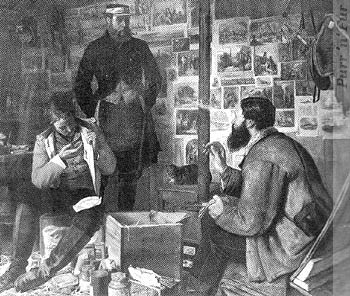
Sevastopol Tom in the officers' quarters - see also enlargement below


Left-click thumbnails for enlargements (JavaScript should be enabled),
but please allow all images to load before doing so, or some may not display
(if this happens, use Refresh from your toolbar to reload the page)


In September 1854 the French and British armies began a siege of the Russian port of Sevastopol (also known as Sebastopol), on the Crimean peninsula. As the weeks went by they were exposed to the rigours of a Russian winter; and in addition to the cold the water was brackish, food was scarce and there was little in the way of medical relief for the wounded. It was a year till the siege ended and the victors were eventually able to march into a largely demolished citadel in search of stores, shelter and warmth.

When the troops were searching the remains of the port one particular cellar was entered by Captain William Gair of the 6th Dragoon Guards (the Carabiniers) and his men. He found a large, wide-eyed tabby cat sitting regarding him from on top of a pile of rubbish between two badly injured people. He was described as 'covered in dust and grime, but serene', and seemed totally unperturbed by the noise and commotion going on around him. He was quite tame and friendly towards the strangers and did not hiss or scratch when Captain Gair approached and bent down to pick him up. Whether he had been someone's pet, or a stray, no one knew, but he appeared to be some 7 or 8 years old. He had survived the whole fierce campaign, lasting nearly a year; but while humans suffered food shortages, there was never any lack of mice in the port area, so cats like him could count on their food supply, summer or winter.

Sevastopol Tom - click to enlarge The cat was taken back to the officers' shelter, where he was much admired, and even though the men were short of food it was noticed that he was sleek and appeared to be in good health. He became known as Tom, and eventually as Sevastopol Tom (or, in some accounts, Crimean Tom), one of the most famous animals in history.

Why? The soldiers had noticed that not only the cats, but also the Russian defenders of the city seemed relatively well fed, despite a lengthy siege, so they must have had continuing access to food supplies; but had those been left behind and, if so, where? That was where Sevastopol Tom came in.

Hurrying out from the military compound and followed by some of the men, the cat stopped at a place near the docks where piles of rubble had denied access to what lay beneath — except to cats! Clearing the rubble, the men gained entry to a storeroom behind — and it was full of food, still mostly edible. Tom, of course, had been attracted by the rats and mice that had also found the food store, but for the occupying troops it meant salvation and the relief of their hunger. Word got around, and in due course Tom showed the way to other caches of supplies, all stockpiled near the waterfront.

There were many hundreds of stray and anonymous cats in Sevastopol, and we can never know what they, and Tom, may have suffered during the military action. But now this particular cat, no longer anonymous, was cherished and hailed as something of a hero. He slept and ate in the officers' accommodation, was brushed and cared for and had plenty of friendly laps to doze on.

After he died Tom's body was stuffed, and it can still be seen today - click to enlarge Finally, when the time came for the soldiers to return to England, there was no way they were going to leave Tom behind — although how they obtained permission to bring him with them remains a mystery. They were very grateful to him and were not going to abandon him. He travelled and marched with them on their journey home and ended his days as the beloved figurehead of one of the most controversial campaigns in British military history — the siege of Sevastopol during the Crimean war.

Tom did not actually survive to a ripe old age; the siege had ended on 9 September 1855, and he died on the last day of the following year. His body was stuffed (above right), as was perhaps more the fashion in those times than it is now, and presented to the Royal United Service Institution.

With acknowledgements to Silent Heroes, an excellent and very readable book by Evelyn le Chene, published 1994 by Souvenir Press of London, ISBN 0 285 63214 0.


More accounts and photos of Cats in Wartime

On Land and In the Air
At Sea


Tom Cat, Confederate mascot


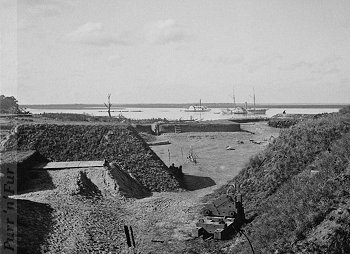
Fort McAllister, with the Ogeechee River beyond, 1864 (Library of Congress)


Left-click thumbnails for enlargements (JavaScript should be enabled),
but please allow all images to load before doing so, or some may not display
(if this happens, use Refresh from your toolbar to reload the page)


Fort McAllister was part of the defensive ring protecting the Confederate city of Savannah, Georgia, during the American Civil War. Unlike its sister fort, Fort Pulaski, it was built of earthworks, sods and mounds of mud from the nearby Ogeechee river, and these earthen walls were very successful in simply absorbing the cannonballs that the Unionists hurled at them. This fort therefore held out much longer than the more modern Pulaski, which fell to Union forces in 1862.

A good view of Fort McAllister showing the earthen defences where Tom Cat used to dodge enemy fire. Dated 1864, after the Fort fell to the Unionists (Library of Congress)  - click to enlarge All kinds of mascot were adopted by soldiers of both sides in the conflict, to relieve the boredom and rigours of camp life. McAllister's cherished mascot was Tom Cat, a large black cat adored by the garrison. He is said to have run back and forth along the defences during battle, dodging the hail of musket fire and cannonballs that flew overhead.

Early in 1863 the Unionists began a series of determined assaults on the fort; during the second of those its commander, Major John B. Gallie, was decapitated. On 3 March the same year Tom's luck ran out when a stray bullet ended his life. His loss was keenly felt by the defenders, but did not signal their defeat; they held out until near the end of 1864, when the fort fell to the unstoppable General Sherman.

Confederate gun at Fort McAllister, 1864 (Library of Congress) - click to enlarge Signal station on the Ogeechee at Fort McAllister, 1864 (Library of Congress) - click to enlarge Today Fort McAllister is the best-preserved earthen fortification in the South, following extensive reconstruction in the 1930s by Henry Ford, who took a great interest, actually buying it and using his own money for the refurbishment. Even at that time, workers on the site refused to spend the night there because of strange, unidentified noises heard in the grounds. Today, visitors, staff and re-enactors have all reported seeing a black cat running along the ramparts, in some of the rooms, and peering out towards the river. Others say they have felt a touch on their legs, as though a furry, arched back was rubbing against them. All the staff and administrators insist that there are no real cats living in the park grounds.

Other visitors — and, during one particular incident in the 1960s, also some of the groundsmen — have reported seeing a headless body, in Civil War-era officer's uniform, pacing near the ramparts. It seems that Major Gallie and Tom Cat continue to mount guard at the fort they defended nearly 150 years ago.

Links for Fort McAllister:
Fort McAllister Historic Park and take link for Historical Information
Our Georgia History: Fort McAllister
GeorgiaInfo

More accounts and photos of Cats in Wartime

On Land and In the Air
At Sea


If you would like to comment please contact me,

Return to:
Featuring Felines index
for more real-life stories and adventures of cats

Other sections:
Famous Felines
Fabled Felines
Feline Folios
Feline Fun
Feline Philately
Feline Fragments
Feline Flotsam

or visit the Purr 'n' Fur home page

Divider

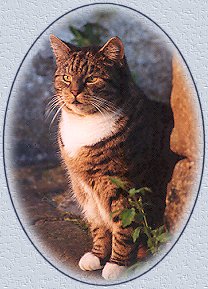
Our featured feline at the head of the page is Socks, pictured in 2003 surveying his 'estate' in the early morning sunshine. Affectionately known as Soxy, he blossomed from a thin and hungry stray into a substantial and handsome cat who loved life and company, and his gentle ways endeared him to many friends. He is now no longer with us, but you can read more from his human companion here.


CustomCount


Copyright © Patrick Roberts & Purr 'n' Fur UK 2003-08
All rights reserved
Images and content (whether original or used at Purr 'n' Fur with permission) may NOT be reproduced
at another website or otherwise copied or used without prior permission.
Direct linking (hotlinking) to ANY images on this site is strictly forbidden.
If you want something, !