
Articles in Famous Felines are written by
Patrick Roberts
Copyright © 2003-17 Purr 'n' Fur UK
Certain features on these pages use JavaScript
|
|
Articles in Famous Felines are written by Certain features on these pages use JavaScript |
[ Home | Famous | Featuring | Fans | Fabled | Folios | Fun | Philately | Fragments | Flotsam ]

|
Left-click thumbnails for enlargements (JavaScript should be enabled),
Jack in disgraceOne Sunday, unfortunately, he was accidentally shut in one of the newspaper rooms and, becoming bored, went around sharpening his claws on the bindings of some of the newspaper volumes, causing considerable damage. Not surprisingly it did not win him any friends; he was banned from the Library and in fact the Clerk of Works was told to get rid of him. But Jack mysteriously disappeared — because two of his supporters had spirited him away to be safely out of harm's way, and kept him supplied with food and milk. It was officially reported that he was 'presumed dead', the newspaper bindings were repaired and life moved on. However, a few weeks later he reappeared, everyone seemed pleased to see him and no questions were asked. The arrival of Mike
Life at the Museum
As time went on Mike began to prefer living at the lodge, where he had free access to come and go as he pleased, day or night, and a special corner shelf, away from draughts, was made available for him to sleep on. But he continued to patrol the Museum, and in return the Keeper of the mummified cats continued to make sure he was looked after; even during the lean years of World War I he made sure that Mike did not go without. The cat led a good life, often being given milk and scraps in the evening by the refreshment-room waitresses, and being frequently entertained in the houses of some of the resident keepers. As did his predecessor, he also liked to grace the Reading Room with his presence. Mike retires
Failing health
TributesThere was a report that an inscribed tombstone had been erected not far from the Museum entrance to commemorate Mike's life, but no trace of it has been found today, despite extensive enquiries, and general opinion is that it was misreported and never actually existed. This is a little strange in view of specific details given shortly after Mike's death, which describe a 'small tombstone, near the Great Russell Street entrance to the Museum' bearing the inscription, 'He assisted in keeping the main gate of the British Museum from February 1909 to January 1929.' It seems more likely that the stone was indeed erected but was later removed or destroyed, or perhaps concealed by subsequent alterations. However, the person reported to be responsible for it, F.C.W. Hiley, Assistant Keeper in the Museum's Department of Printed Books, also composed a splendid Memorial Poem. Below is its ending, and the whole work is appended at the end of this article.
Old Mike! Farewell! We all regret you, In 1979, 50 years after the cat's death, a short 'Jubilee Reminiscence', in a limited edition, was prepared by R. B. Shaberman and reprised Mike's life. The two cartoons are taken from it, with acknowledgements to the author and to publisher Arthur Page of The Bookshop, Bloomsbury, London. Later catsOther cats followed Mike, although many remain anonymous. There was Belinda, an odd name for a ginger tom; he is remembered as 'a strong character, given to keeping warm on motor cars'. Suzie succeeded him; she was a black-and-white female who moved in with the warders and never missed a patrol of the buildings. Unlike Mike she liked people and became a familiar sight to visitors and staff alike; she died in May 1982 at the age of 16, prompting the Museum to print a short obituary in its Bulletin. Later there were Maisie and her offspring Pippin, Poppet and Pinkie; and Suzie the Second, who spent much of her time with workmen in the Control Room. When she became too old for life there she was retired to a private home. Unfortunately, as is the case with many former feline domains, there are today no longer any cats at the Museum.
The above account of Mike is adapted from a pamphlet written in February 1929 'at the request of many friends of Mike' by his champion, Sir Ernest Wallis Budge, to commemorate the famous cat's life. It is entitled MIKE — the CAT who assisted in keeping the Main Gate of the British Museum from February 1909 to January 1929, and was published by Richard Clay & Sons of Bungay, Suffolk. Time magazine evidently considered Mike's passing worthy of note, publishing an obituary in April 1929, and in January of the following year it also carried news of Budge's pamphlet (note that both links go to previews consisting of the first couple of paragraphs in each case; subscribers to Time can read the pieces in full by logging in). Grateful thanks go to the British Museum and especially to Dr Patricia Usick, Honorary Archivist, Department of Ancient Egypt and Sudan, for providing us with a copy of the pamphlet. Also to Dr Elizabeth Chase, City of London and Parliamentary Guide, for her valued help in trying to track down Mike's apparently non-existent tombstone. * * * * * * * * * * TO THE MEMORY OF All ye that learnèd hours beguile
* * * * * * * * * * Read about more museum cats in our Featuring Felines section |
If you'd like to comment, or have further information about any of the British Museum cats,
please contact me,
or drop in at our Facebook page

Return to:
Famous Felines index
Other sections:
Featuring Felines
Fans of Felines
Fabled Felines
Feline Folios
Feline Fun
Feline Philately
Feline Fragments
Feline Flotsam
or visit the Purr 'n' Fur home page

'Catline' divider bar courtesy of CatStuff Graphics

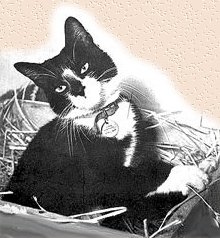
Our featured feline at the head of the page is Simon of HMS Amethyst.
He remains the only cat ever to have been awarded the Dickin Medal for gallantry under enemy fire,
in what became known as the 'Yangtse Incident' (1949).
Read Simon's story.
Copyright © Patrick Roberts & Purr 'n' Fur UK 2003-17
All rights reserved
Images and content (whether original or used at Purr 'n' Fur with permission) may NOT be reproduced
at another website or otherwise copied or used without prior permission.
Direct linking (hotlinking) to ANY images on this site is strictly forbidden.
If you want something,
!
Page first created August 2011 with later revisions and additions
 "The British Museum, London, in the early 20th century - click to enlarge")
 "Cartoon from a 1979 commemoration of Mike published on the 50th anniversary of his death; it shows Mike's arrival at the museum, courtesy of Black Jack - click to enlarge")
 "Original 1929 caption: Mike in a benevolent mood (after a fish lunch!), sitting for his portrait - click to enlarge")
 "Cartoon from a 1979 reminiscence of Mike marking the 50th anniversary of his death - click to enlarge")
 "Original 1929 caption: Mike expressing his opinion of a dog he had just driven out of the Courtyard of the Museum. Following his death, this image of Mike was used on postcards - click to enlarge")
 "Mike, the British Museum Cat, copyright Frances Broomfield and used with permission - click to enlarge")