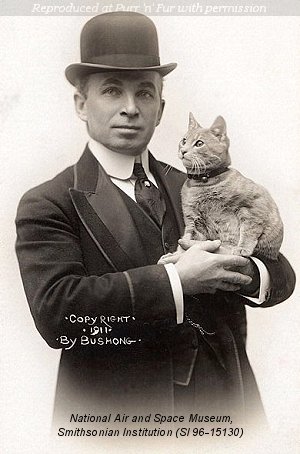
 Kiddo was the first cat to take to the air over the Atlantic Ocean in an airship, although the crossing was not completed. He was a grey tabby, one of former stray twin cats that lived around the airship hangar, but unfortunately his brother was killed there by a wolfhound, a few weeks before the flight. Kiddo — usually referred to by the crew as 'Kitty' — belonged to one of the crew members of Walter Wellman's airship America. Wellman (1858-1934) was an American explorer, aeronaut and journalist. He persuaded three newspapers — the New York Times, the Chicago Record-Herald and Britain's Daily Telegraph — to finance a new venture.
In 1910 he and five companions attempted to cross the Atlantic ocean, leaving from Atlantic City, New Jersey on 15 October that year — delayed from August, as the craft hadn't been ready.
It was just at the last minute that Kiddo was thrown up into the lifeboat under the airship, where radio operator Jack Irwin had his post, and the cat spent much of his time cuddled up in the 'wireless corner'. A motorboat, occupied by journalists, towed the airship away from land until deep water was reached, and then cast it off when the sea became too rough for the small boat. The airship immediately disappeared from view into a dense fog bank. While that was going on Kiddo really did not seem to enjoy his first experience of flying, mewing, howling and rushing around 'like a squirrel in a cage', according to the log, and generally getting on the nerves of the first engineer, Melvin Vaniman. The America was the first aircraft to be equipped with radio, and apparently the historic first, in-flight radio message — to a secretary back on land — read:
Roy, come and get this goddamn cat!
Navigator Murray Simon thought the cat should stay, as they would have no luck without him, but a crew conference decided that he should be returned to shore.


 Kiddo was unceremoniously stuffed into a canvas bag, with the idea that he would be lowered into the motorboat beneath the airship. The bag, wriggling furiously, was lowered to just above the sea, but the weather was too rough for the boat to reach it and so it was hauled back up again. Kiddo soon regained his equilibrium and his spirits and behaved 'fairly well'; indeed, the crew found him 'more useful than any barometer. You must never cross the Atlantic in an airship without a cat,' as Murray Simon put it. 'He is sitting on the sail of the lifeboat now as I write, washing his face in the sun: a pleasant picture of feline contentment. This cat has always indicated trouble well ahead. Two or three times when we thought we were "all in" he gave most decided indications that he knew we would be shortly getting it in the neck.' The cat did not like it when the weather became rough and the airship lost height, though; he became agitated and, as Simon describes, was 'howling piteously. I never heard a cat make such a noise.' Kiddo was thrown into a hammock and had a blanket put over him, which calmed him down.


 Unfortunately the weather — a storm from the north-east blew them way off course — and various other problems, including difficulties with the engines, meant that the Atlantic crossing could not be completed, and eventually the ship had to be ditched and the crew, cat included, took to the lifeboat. They were rescued by the British steamship RMS Trent, which was en route from Bermuda to New York and with which they had been communicating by Morse lamp. When the boat had been hauled aboard Trent, Kiddo was found to be fast asleep in the aft chamber where he had been secured, but he started howling again when he saw the unfamiliar surroundings. However, he 'settled down to a breakfast they brought him'. Simon reminded the crew that it had been a good idea to bring a cat, as they have nine lives!
On being liberated from the weight of the lifeboat and crew when they had cut it loose to make for the Trent, the airship 'shot skyward', was taken by the wind and drifted away, never to be seen again.
When the rescue had been effected, Captain Down, master of the Trent, sent a message to the shipowner's agents in New York:
|
At 5 a.m. today sighted Wellman's airship America in distress. Signaled by Morse code that he required assistance and help. After three hours' maneuvring and fresh winds blowing, got Wellman with his entire crew and cat. Were hauled safely on board. All are well. The America was abandoned in latitude 35:43 north, longitude 68:18 west.
DOWN, Master.
|
In an account of the rescue a few days later, Down said, '... I had the pleasure of welcoming aboard Mr. Wellman and his five lieutenants and a cat which seemed little the worse for its air experience.' However the New York Times detected a note of amusement from the agents for the Trent: 'Details of the rescue that appealed to the company's officials here was the saving by Capt. Down of the pet cat, for the Captain's antipathy to felines is well known to his friends.'

 A tugboat came out to take the ship into New York, where a tumultuous welcome awaited the intrepid crew of America. Kiddo, now renamed Trent in honour of the rescue ship, achieved celebrity status by being displayed for a while in Gimbel's, one of the leading department stores of the time, where he reclined on soft cushions in a gilded cage. A photo was reproduced as a postcard. Although the Atlantic had not been crossed, the America had broken all records by remaining aloft for almost 72 hours, and during that time had travelled just over 1000 miles (1600 km). A great deal of useful information had been gained, which could be put towards a future attempt — 'and we saved the cat!'
Kiddo, aka Trent, retired from aviation to live with Walter Wellman's daughter Edith, but Vaniman was not so fortunate, as he died when the airship Akron, on which he was intending to make another Atlantic attempt, crashed at sea on 2 July 1912, killing all on board.
More details of the voyage and of the airship itself, as well as a reappraisal of the enterprise after a century, can be found at the Daily Telegraph: America the airship: the first transatlantic crossing (October 2010).
|
The top photo of Kiddo with Melvin Vaniman (by 'Bushong', 1911) is used by kind permission of the National Air and Space Museum, Washington, DC, and may not be copied for use elsewhere.
|
Notes
-
 Kiddo was not the first cat to become airborne — one feline took to the air in a balloon nearly 130 years before the airship America's flight. In 1785 one George Biggin, together with pioneering Italian aeronaut Vincenzo Lunardi (known as 'The Daredevil Aeronaut'), decided to demonstrate a hydrogen-filled balloon flight at the Artillery Ground of the Honourable Artillery Company in London. However, the 200,000-strong crowd — which included the Prince of Wales — started to become very impatient and Lunardi was obliged to take off without Biggin, and with a bag that was not completely inflated. He was accompanied by a dog, a cat and a caged pigeon, and presumably the flight was successful as his balloon was later exhibited at the Pantheon in Oxford Street.
- Tabby kitten Wopsie, later renamed Jazz by American admirers, outdid Kiddo in July 1919 when he stowed away aboard British airship R-34 and became the first cat to complete the trans-Atlantic crossing from Britain to America. He was brought on board by a human stowaway, William Ballantyne. They hid in the cramped space between the girders and the gas-bags, but not long into the flight Ballantyne became ill and nauseous and had to reveal himself. There wasn't much to be done, as the airship was by then over the Atlantic, so after recovering Ballantyne worked his passage as cook and general factotum. As for Wopsie, he was looked after by George Graham, the oldest airman on board, and earned his place by providing entertainment and comfort to the other crew members. He became the airship's regular mascot until it crashed in 1921; the only injury was to Wopsie, who suffered a bruised paw. We don't know anything of his later history.
Some of the information about Kiddo comes from Allan Janus's marvellous book about animals that have flown in balloons, planes and airships, Animals Aloft (Bunker Hill Publishing, Piermont, New Hampshire, 2005). We are also most grateful to Allan for his help with obtaining permission for Kiddo's and other photos belonging to the National Air and Space Museum in Washington DC. You can read about Allan's own cats Max and Maxine here.
Further information has come from Murray Simon's log of the airship's journey, which is available online at the New York Times (subscription required; many other articles published by the NYT before, during and after the venture are also available), and from the Daily Telegraph linked above.




 "Walter Wellman on board one of his polar-exploration airships - click to enlarge")
 "Walter Wellman - click to enlarge")
 "Murray Simon, British navigator of the airship America, 1910 - click to enlarge")
 "The airship America, manoeuvring off the steamship Trent prior to the crew being picked up, 1910 - click to enlarge")
 "Crew aboard the Trent, with Vaniman holding the cat - click to enlarge")
 "Melvin Vaniman with Kiddo aboard the steamboat Trent, 1910 - click to enlarge")
 "Kiddo with Melvin Vaniman and Murray Simon - click to enlarge")
 "Kiddo was renamed Trent - click to enlarge")
 "In London in 1785 Vincenzo Lunardi took to the air in a ballon with a cat, a dog and a caged pigeon - click to enlarge")